This web page is intended to present the work in Tropical Ecology and Conservation that I am doing in my position as an Associate Professor and Researcher at USFQ. As a parallel objective also, the information presented here is to create links between Ecuadorian scientists and researchers from all over the world interested in collaborating and knowing about our work.
Please take a look below in this page, for more details about my research.

As a result of more than 20 years working in tropical areas and learning first-hand about their ecological and conservation-related complexities, I presently have a well-defined, interdisciplinary, very collaborative, and recognized research agenda in important regions like the iconic Galapagos National Park and the megadiverse Yasuní Biosphere Reserve (YBR) in the Amazon. This research agenda and expertise concentrates in three primary areas: Biological Invasions and Restoration, Plant Ecology and Biogeography, and Conservation and Management. I also use herbarium records, molecular tools, technological platforms (unmanned aerial vehicles-UAVs), Geographic Information Systems, citizen science, and spatially explicit modelling as complements to obtain higher-impact and efficient results.
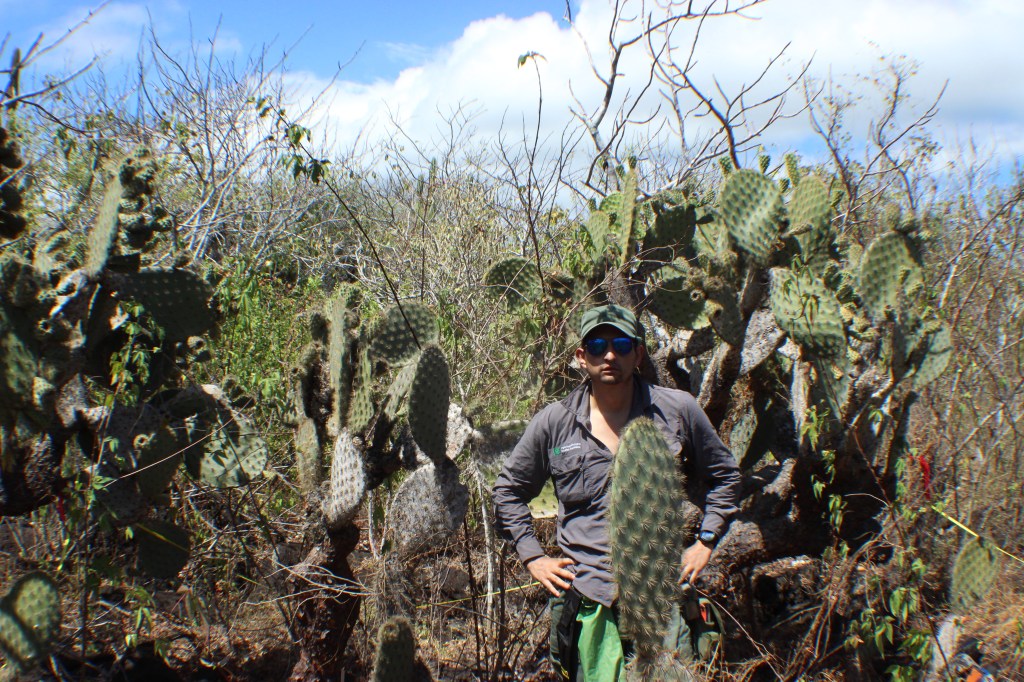
I am also personally interested in two debates: first how we can use available scientific data to achieve better and more effective conservation practices in my country and second, discussing about the future of biodiversity in our changing world. The sections in this web page are dedicated to show these interests that are the main core of my research agenda.
More about my present position at USFQ here
MY RESEARCH IN A NUTSHELL…
Biological Invasions and Restoration
In collaboration with the Galapagos National Park and colleagues at University of Florida, I am leading the mid- and long-term impact assessment of the invasive tree Cedrela odorata in the Galapagos. In 2012, I established a large-scale experiment to remove this canopy-dominating tree in order to simulate restoration techniques and understand its effects over native, endemic and invasive flora. In addition to this continuing project (following the fate of native/endemic and invasive plants in experimental plots with and without Cedrela and using UAVs –and special sensors– to measure other ecosystem-level impacts caused by this tree, i.e. changes in plant distributions and biomass); I am also determining (with the help of molecular markers) the source, number of introductions and gene flow of the recorded Cedrelapopulations in the Galapagos. Using these same Cedrela monitoring plots I am also assessing, among other issues, how the presence of invasive ants is apparently benefiting invasive plant hosts by defending them from herbivores that usually reduce plant growth in co-occurring species lacking these defensive insects.
The next steps in this project, which I have been able to successfully direct with full participation from the Galapagos National Park, involve a bi-annual census of the Cedrela experimental plots and drone campaigns to map plant biodiversity changes on site and specifically, how invasive plants and their impacts are currently developing in the locations this invasive tree is recorded. I envision to continue applying molecular tools and restoration-type treatments to these Cedrela experimental plots in the next 10 to 20 years (and in the long run), in order to understand and predict how managerial and restoration actions affect native, endemic and invasive plant population dynamics in this archipelago.

Plant Biogeography and Ecology
I am presently working (in direct collaboration with the Galapagos National Park, the Real Jardín Botánico de Madrid, San Francisco State University and the Fort Lewis College Herbarium) on the phylogenetic reconstruction of the Scalesia (Asteraceae, Asterales) genus. Scalesia is an endemic genus in the Galapagos, with ~15 species dispersed across the archipelago (many Critically Endangered and rare) and is the evolutionary and ecological equivalent of the Darwin finches in plants. Using widespread plant records and modelling (GLMs, ENFA and Maxent), this project also seeks to describe the biogeographic patterns of all the Scalesia species to understand how plant speciation takes place in the most iconic Galapagos flora taxon. In the next three years, the results of this investigation are expected to help explain whether mechanisms like adaptive radiation are working to shape the present distribution of Scalesia and other ecologically similar endemic genera. The first full phylogeny for this group was published in 2020, and together with the definition of population sizes and distribution patterns and models, this research will provide the most updated information regarding the evolution, ecology and conservation status (including population sizes, necessary to re-define IUCN categories) for this significant and unique group.
Additionally, I am using and flying UAVs (equipped with near-infrared and NDVI sensors) and satellite images to generate accurate maps and measure the impacts (i.e. effects over biomass and carbon sequestration) of the most invasive plant species in Galapagos. These mapping campaigns also include the detailed description of native ecosystems and endemic flora distributions. Together with my collaborators (Galapagos National Park, USFQ-GIS Institute and UNC-Chapel Hill), I have generated, for the first time using a hybrid and low-cost procedure, the most up-to-date Galapagos vegetation maps. I am also currently producing maps with the “historical” distribution of the main native and invasive plants to contrast them with present day results. The next step for this research project will be the creation of future distribution maps, to evaluate how coverage of endemic and invasive plant species and ecosystems will vary under distinct predictive climatic scenarios projected for this archipelago.
Also in Galapagos, (and in partnership with the Galapagos National Park, GLONAF, sPlots-iDIV, UM, Fort Lewis and UCLA), I have been able to establish and re-measure a group of ~200 experimental vegetation dynamics transects/plots located all over the archipelago, where relevant abiotic and biotic variables, functional and plants traits and molecular samples are also recorded for on-going ecological, biogeographical, population dynamics and molecular analyses. The resulting databases of this long-term project are secured and curated under the strict protocols developed by these collaborative platforms, and thus are now included in global datasets and new open-access initiatives like the eFlora of Galapagos (under construction), DryFlor and sPlots-iDiv. Other important results from this project are the description of a new plant species and the updating of a species that was recorded as extinct in the past for the Galapagos.
As part of my efforts to record biodiversity and strengthen collaborative networks throughout the Biological world, I am also presently in charge of the re-census and taxonomic curation of 10 one-hectare plots located in the Ecuadorian Amazonia-YBR that are part of the renowned ATDN, Rainfor and ForestPlots initiatives (which so far have resulted in several published papers including two in Science journal). This project is also allowing us to understand biodiversity and temporal changes in tree populations and describe new species of trees from continental Ecuador.
In 2017, I began to also use UAVs in this region (to make multi-temporal comparisons) equipped with infrared and high definition cameras in transects of ~100 hectares located in the three dominant ecosystems of the YBR, which include the one-ha plots experimental units described before as ground-truthing units. I am now testing, along with colleagues from the USFQ-GIS, UNC and University of Amsterdam, as part of one of the two Master’s programs I helped to develop, the use of UAVs’ infrared images to perform biomass calculations per ecosystem (calibrated by biomass calculations from plot data) and the automatic recognition of conspicuous canopy plants recorded in the high-resolution images taken by these aerial drones. Future phases of this project include working to improve machine-learning techniques, to automatically recognize tree species in large photomosaics using for example, crown shape and light reflectance variations among different taxa.

Conservation Biology and Management
The Conservation Biology and Management-related projects I presently have in areas like Galapagos and YBR use basic science data collected mainly by the above-described investigations to inform decision-making actions. For example, with the close collaboration of Galapagos National Park staff, I am using data collected by our multiyear drone-mapping projects to assess the rate of change in endemic and invasive plant vegetation distributions in this archipelago. Due to a need expressed by our Galapagos NP partners, my laboratory (along with colleagues from the University of Leipzig) is also complementing this effort with the inclusion of iconic fauna UAV monitoring in different sites all along the archipelago. The outcomes of such initiatives not only help the Galapagos NP to know the conservation status of endemic flora and fauna, but also generate high-impact conservation tools (like citizen science projects and educational videos broadcasted for the BBC) showing, among others, iguana distributions based on drone images (project launched in Zooniverse platform), newly discovered sea lion behaviors, and the use of UAVs to help protect the Galapagos archipelago.
Relevant spatial data generated by my mapping projects and parallel on-going and published studies for example, are allowing us to precisely know the extension, environmental niches, and economic impacts of the main introduced plant species in the terrestrial protected area of the Galapagos.
I am also using this data to perform “invasibility” and feasibility analyses and EICAT protocols (in collaboration with University of Fribourg) to prioritize restoration in this protected area.
The estimated outcomes will serve as conservation instruments that can be constantly updated, helping the Galapagos NP to assess threats to native-dominated ecosystems and to considerably reduce management-related costs. Additionally, projects analyzing genetic connectivity among invasive plant species populations in Galapagos are also generating relevant results to help understand how invasive taxa are moving in the archipelago and the necessary conservation measurements to take, which will aid in preventing their range expansion.
 The Plant Ecology Lab @ USFQ - Gonzalo Rivas-Torres